
The Ultimate Guide to Roofing Manufacturer's Warranties: What Every Homeowner Needs to Know
If you're considering a new roof or have recently had one installed, understanding roofing warranties can save you headaches down the line. But warranties can be complex, with fine print that many homeowners overlook. This guide will break down the components of roofing warranties, explain the differences between basic and premium options, compare popular brands, and highlight key points homeowners need to know.
The Basics of Roofing Warranties
Roofing warranties generally cover two main areas:
1. Materials Warranty
- Covers manufacturing defects in shingles and other components (like underlayment or ridge caps).
- May last anywhere from 25 years to "lifetime," depending on the product and warranty tier.
In the context of roofing warranties, "lifetime" typically refers to the period during which the original homeowner owns the property. However, this may vary based on the manufacturer's specific terms, so it's essential to review the fine print for precise definitions.
2. Labor (Workmanship) Warranty
- Covers errors made during installation, such as improper nailing or poor alignment.
- Usually installation labor is only warranted by the contractor installing the roof.
- Important: Some premium manufacturer's warranties will cover the contractor's workmanship! More on that later.
What Will the Warranty Actually Pay For?
Even if the warranty covers fixing an issue, it may not cover 100% of the cost to fix it. For example when replacing a shingle you need to tear off the old shingle, procure the new shingle, and then install the new shingle. A warranty may only cover the cost of procuring the new shingle, leaving the property owner to cover the tear off costs and cost of the labor to install the new shingle.
Understanding Proration
Most warranties are prorated in some way. Non-prorated coverage (full coverage) is typically limited to 10-20 years. After that, coverage is reduced based on the roof's age. For example, after 40 years, you may only get 20% of the replacement cost.
Consequential Damages Are Not Covered
The warranty will also not cover consequential damages. So if there is a roof leak due to a material defect and water comes into the house, the warranty will not cover water damage.
Quick Comparison: What Does Each Warranty Cover?
Below is a quick reference showing what costs are covered by standard vs. premium warranties from the three major manufacturers.
| Warranty Type | Materials Coverage Costs | Labor Coverage Costs | Tear-Off & Disposal Coverage | Non-Prorated Period |
|---|---|---|---|---|
| CertainTeed Standard | ✓ First 10 years | ✗ Minimal or none | ✗ No | 10 years |
| Owens Corning Standard | ✓ First 10 years | ✗ Minimal or none | ✗ No | 10 years |
| GAF Standard | ✓ First 10 years | ✗ Minimal or none | ✗ No | 10 years |
| CertainTeed 5-Star | ✓ Up to 50 years | ✓ Up to 25 years | ✓ Fully covered | 50 years |
| Owens Corning Platinum | ✓ Up to 50 years | ✓ Up to 25 years | ✓ Fully covered | 20 years |
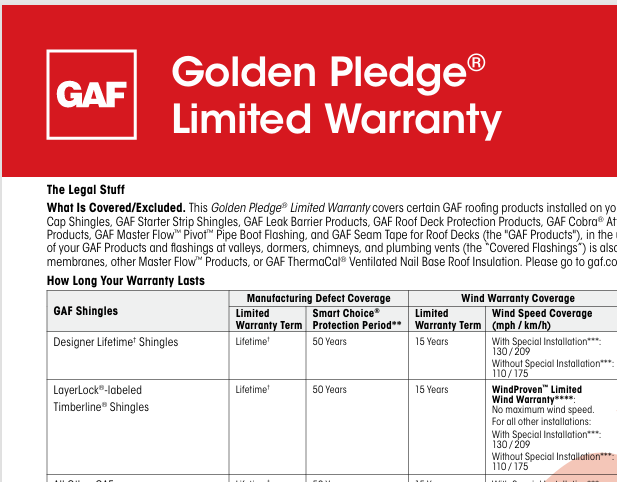
| GAF Golden Pledge® | ✓ Up to 50 years | ✓ Up to 25 years | ✓ Fully covered | 25 years |
Basic vs. Premium Warranties
Major manufacturers offer premium warranties that offer significantly more coverage than their standard warranty. These premium warranties come with much longer non-prorated coverage periods, coverage of all costs to remedy a defect (tear off, new material, labor to install new material), and most importantly the manufacturer will warrant the contractor's labor!
Premium warranties don't just cover materials—they also cover installation labor for 10-25 years and include tear-off and disposal costs. This can save you thousands of dollars if an issue arises.
Key Differences Between Basic and Premium Warranties
| Feature | Basic Warranty | Premium Warranty |
|---|---|---|
| Coverage Duration | Typically 25-50 years (materials only) | Lifetime on materials, often with 10-25 years of full coverage for labor and materials |
| Labor Coverage | ✗ Limited or none | ✓ Covers workmanship errors for 10-25 years |
| Transferability | Often reduced coverage after 1 transfer | Generally allows 1 transfer with full coverage during a specified period |
| Eligibility Requirements | Minimal (any contractor can install) | Requires certified contractor and complete roofing system |
| Proration | Starts after a short non-prorated period | Longer non-prorated periods, typically 10-20 years |
Detailed Manufacturer Warranty Comparison
Manufacturers have some differences in their warranties. For full details, please refer to the manufacturer's warranty documents. Below we'll see a comparison of warranties from 3 major manufacturers. We show a standard and premium warranty from each.
CertainTeed, Owens Corning, and GAF: Side-by-Side Comparison
| Warranty Feature | CertainTeed Standard | CertainTeed 5-Star | Owens Corning Standard | Owens Corning Platinum | GAF Standard | GAF Golden Pledge® |
|---|---|---|---|---|---|---|
| Materials Coverage | Lifetime, prorated | Lifetime, non-prorated (50 years) | Lifetime, prorated | Lifetime, non-prorated (20 years) | Lifetime, prorated | Lifetime, non-prorated (25 years) |
| Labor Coverage | Minimal or none | ✓ 25 years | Minimal or none | ✓ 25 years | Minimal or none | ✓ 25 years |
| Tear-Off & Disposal | ✗ No | ✓ Fully covered | ✗ No | ✓ Fully covered | ✗ No | ✓ Fully covered |
| Non-Prorated Period | 10 years | 50 years | 10 years | 20 years | 10 years | 25 years |
| Transferability | Limited, reduced | Full coverage for 15 years | Limited, reduced | Full coverage for 20 years | Limited, reduced | Full coverage for 20 years |
5 Critical Things You Need to Know About Using Your Warranty
1. Contractor Must Register the Warranty
Premium warranties require the contractor to register the warranty with the manufacturer. If this step is missed, you may lose access to full coverage. The contractor also needs to use all of the required components from the manufacturer to get a premium warranty.
Make sure to keep a record once your warranty is registered! The manufacturers will also have a record of your warranty in their database. Without proper registration, your premium coverage may be void.
2. The Claims Process Can Be a Lot of Work
Filing a claim often involves providing proof of purchase, photos, or even shingle samples. You're also required to notify the manufacturer within 30 days of discovering an issue.
What You'll Need to File a Claim:
- Proof of purchase and warranty registration
- Clear photos of the defect or damage
- Shingle samples (in some cases)
- Notification within 30 days of discovering the issue
3. Roof Maintenance is Key
Most warranties require regular maintenance, such as cleaning gutters, ensuring proper ventilation, and avoiding damage from debris. Failure to maintain the roof can void the warranty. Document your roof maintenance activities with photos and receipts. This can protect your warranty if you ever need to file a claim.
4. Act of God Exclusions
Hail, extreme winds, and other natural disasters are typically not covered by roofing warranties. Homeowners should ensure their insurance policy covers these events. In these situations, you'll need to lean on your homeowners insurance.
5. Transferability Restrictions
Warranties often allow one transfer, but terms can change significantly after the transfer. For instance, Owens Corning and GAF's standard warranties reduce coverage to just 2 years if the warranty is transferred after the initial non-prorated period. Check your warranty's transferability terms before listing your home for sale. Premium warranties typically offer better transfer terms, which can be a valuable selling point for potential buyers.
Final Thoughts
Roofing warranties can be a lifesaver when things go wrong, but they're not all created equal. By understanding the differences between basic and premium options and what to watch for in the fine print, you can make a more informed decision about your roof and protect your investment for years to come.
- Premium warranties offer significantly more value with labor coverage and longer non-prorated periods
- Always register your warranty with the manufacturer—don't rely on your contractor alone
- Keep detailed maintenance records to protect your warranty coverage
- Read the fine print on transferability if you plan to sell your home
- Combine warranty coverage with homeowners insurance for complete protection
When choosing a roofing system, factor in not just the upfront cost but the long-term protection a premium warranty provides. The peace of mind and potential savings can be well worth the initial investment.
Want to compare warranty options? Get quotes here to see pricing from contractors who offer premium warranty coverage.