
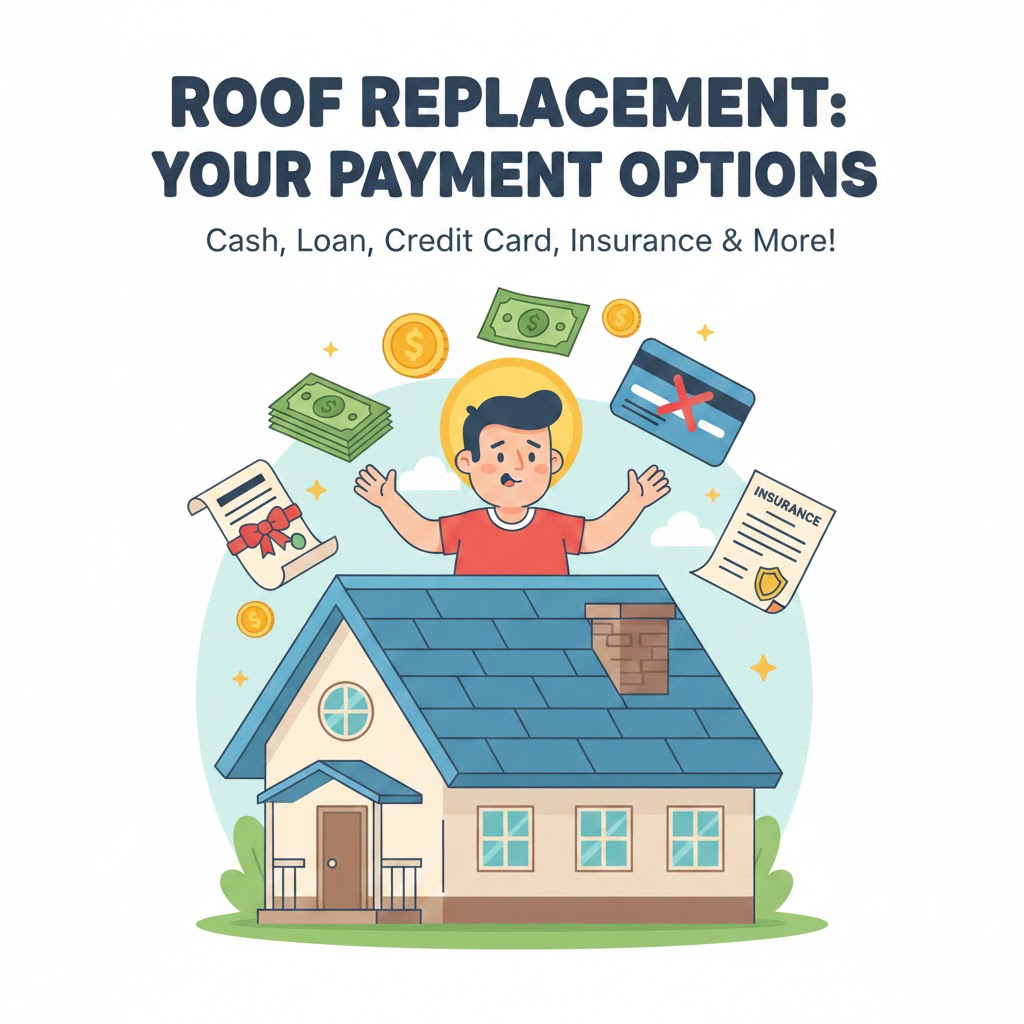
How to Pay for a New Roof: Complete Financing Guide for Homeowners
Replacing the roof is generally the most expensive home maintenance item that you'll need to handle as a homeowner. This article will go over financing options available to homeowners.
Our Top Recommendations
Here's our recommended approach to financing your roof replacement:
- Check with insurance if you live in an area that has major storms
- Cash is good if you've got it
- Compare financing options - The financing offered by your contractor can be good, but a little effort looking into more finance options can go a long way! We provide guidance on where to look and what to look for
If you're in a situation with a low credit score and income, there are still options available. We'll cover special programs and alternatives throughout this guide.
Insurance Coverage
Many homeowners have an insurance policy that includes coverage for damage from weather. If your roof has been damaged by a storm or other covered event, filing an insurance claim may significantly reduce the cost of replacement.
Even if you aren't totally sure if your roof has been damaged, it's generally worth having an adjuster come out if you live in an area that has been hit by hail or windstorms in the last few years.
Insurance claims can save you thousands of dollars, so this should always be your first consideration in storm-prone areas.
Cash Payment Options
Direct Payment (Check or Bank Transfer)
While paying in literal cash is not very common, paying by check or bank transfer is an easy and simple way to process the payment for a roofing project. In fact, most deals that aren't being financed will usually be paid in this method.
Benefits:
- No interest charges
- No fees
- Simple and straightforward
- Often results in better pricing from contractors
Credit Cards: Generally Not Recommended
A credit card is almost never a good way to pay for a major home improvement project.
Here's why credit cards don't work well for roof replacements:
- High processing fees - Because it's such a large purchase, contractors pay significant fees to process credit cards and must pass those charges along to you
- High interest rates - You'll rack up massive interest if you don't pay the cost off immediately
- Credit utilization - A large purchase can negatively impact your credit score
Bottom line: Whether you have funds available or not, you should avoid paying by credit card.
Contractor-Offered Financing
Many contractors offer financing options. These plans are often very easy to set up, with instant approval and all-digital processes.
Pros
- Convenient and fast approval
- All-digital application process
- One-stop shopping
Cons: Watch Out for Hidden Fees
Some contractor-offered finance options come with significant fees that are often hidden from the consumer.
While these fees do earn you a lower interest rate, it's important to know that you are paying a higher price for that lower rate. Paying fees to get a lower interest rate can be worth it if you:
- Plan on staying in the home through the term of the loan
- Don't plan on paying off the loan early
In the solar space, we've seen loans that add on as much as 45% to the price of the project as fees that are hidden from the customer!
How to protect yourself: Get multiple bids on projects. It will become apparent if a bid is marked up significantly for finance fees.
Self-Secured Financing Options
Getting financing on your own can be more work than using the contractor's finance options, but for a major project like a roof, it's worth the effort.
The Savings Potential
Example: For a $15,000 roof financed over 15 years with decent credit, you can expect to save around $350 per year if you get a home equity loan or personal loan from a credit union rather than contractor financing.
Types of Financing
Unsecured Loans (Personal Loans)
Also called personal loans or home improvement loans, this is a common way to get money for your project.
Where to get them:
- Contractors
- Banks
- Credit unions (generally the best rates)
- Non-bank lenders
Best for: Homeowners who don't have significant home equity or prefer not to use their home as collateral.
Home Equity Loans and HELOCs
These products are secured by the equity you own in the home.
Advantages:
- Lower interest rates
- Qualify for more credit compared to unsecured loans
- Potential tax deductions when used for home improvements
Disadvantages:
- Your home is collateral - not paying can lead to foreclosure
- More complex application process than unsecured loans
We think home equity loans are a pretty good option for paying for necessary projects like a roof. We recommend a fixed-rate loan rather than a HELOC.
Home Equity Loan vs HELOC:
- Fixed Home Equity Loan: Set rate, predictable monthly payments
- HELOC: Line of credit with variable rates (like a credit card)
Home equity loans may also have tax deductions available if used to pay for major home improvements, which further cements them as one of the lowest-cost ways to pay.
Solar Loans: A Smart Combination
Getting your roof replaced is the best time to go solar. You'll be able to line up the lifespans of your roof and solar system.
Why this matters: If you get your roof replaced and then go solar 10 years later, you're almost certainly going to have to remove and re-install the panels in the future when the roof needs replacement. Removing and re-installing solar panels can cost $200-350 per panel - that adds up fast!
Benefits of Solar Loans:
- Better rates - Solar loans generally have better rates than other home improvement loans
- Include roof costs - Most solar loans allow you to include some or all of the costs of your roof in the loan
- Lower monthly expenses - Your solar payment plus remaining electric bill should be lower than your current electric bill
- Better financial position - Because your monthly expenses decrease, you're in a stronger position to repay the loan
There are many bad solar companies and misleading sales practices out there. Solar is a great product, but it's very important to be informed as a homeowner. Make sure to research thoroughly and get multiple bids.
Where to Get Financing
| Lender Type | Pros | Cons | Best For |
|---|---|---|---|
| Credit Union | Excellent rates for qualified borrowers | More paperwork, slower process | Homeowners willing to put in effort for savings |
| Traditional Bank | Straightforward process, established relationships | Higher rates than credit unions | Homeowners with existing banking relationships |
| Non-Bank Lenders | Fast approvals, flexible options | Higher interest rates | Borrowers with less-than-perfect credit |
| Government Programs | Very good subsidized rates | Extensive paperwork | Those who qualify and have patience |
1. Credit Unions
Credit unions have really good rates available to qualified borrowers. The downside is that the application process requires more work.
Many homeowners we recommend to credit unions do not have the patience to get through the process and just use contractor-offered financing. If you're willing to go through a few phone calls and provide the documents they need, the reward is significant.
2. Traditional Banks
Traditional banks provide personal loans and home improvement loans, which can be a straightforward option if you qualify. If you have an existing relationship with a bank, start there.
3. Non-Bank Lenders
Non-bank lenders, such as fintech companies and peer-to-peer (P2P) platforms, often provide faster approvals and more flexible options compared to traditional banks and credit unions.
They are a great choice for homeowners with less-than-perfect credit or those looking for convenience. However, interest rates may be higher, and terms can vary significantly, so it's important to carefully review the details and compare offers.
4. Special Government Programs
Some regions have government-sponsored programs that can provide excellent rates. They usually require a lot of paperwork, but can be a great deal.
Examples:
California - GoGreen Financing: A state-subsidized credit union loan that can be used to pay for a roof and other projects. The rates are very good.
PACE (Property Assessed Clean Energy):
PACE has gotten a bad reputation due to aggressive and sometimes fraudulent sales tactics from contractors that have put many homeowners in bad situations. PACE is not an inherently bad product, but it is important to be well informed when using it.
Benefits:
- Especially useful for homeowners with poor credit (no credit score required)
- Homeowners with poor credit can get rates normally only available to borrowers with better credit
- Potential tax deductions
- Repayments are part of your property tax bill
Risks:
- Like a mortgage or home equity loan, the home risks foreclosure if you don't pay
- Some contractors have used misleading sales tactics
Alternative Options for Specific Situations
Reverse Mortgage
For older homeowners, a reverse mortgage could be an option. This allows you to access your home's equity without monthly payments, but it's important to understand the long-term implications for your estate.
This is a complicated product that can be risky. We recommend looking into it if you are elderly, have lower credit, and have a critical project like replacing a roof that needs to be done.
Grants and Assistance Programs
Grants for roof replacements are rare but may exist in some regions for low-income homeowners or specific situations. In some areas prone to hurricanes, there are also programs that help cover projects that make the home more hurricane-resistant.
Reality check: Any grant program will come with significant paperwork, and very few homeowners that explore this option actually end up receiving anything. Don't rely on grants as your primary financing strategy.
Step-by-Step: How to Approach Your Roof Financing
This was a lot of information. Here's how to tackle it systematically:
Step 1: Check Insurance (If Applicable)
If you live in an area with major storms, first check with your insurance company about filing a claim. If you're paying for a policy that will help replace your roof, you certainly want to use it if you have legitimate storm damage.
Step 2: Get Multiple Bids
Get bids for your project and see what financing the contractors can provide. Multiple bids will help you:
- Understand the true cost of your project
- Identify if any contractors are inflating prices for financing fees
- Compare contractor-offered financing terms
Get free quotes from local contractors to see what your roof will actually cost—no phone calls required.
Step 3: Explore Solar
Look at solar and see if it makes sense for your situation. This could be the perfect time to:
- Lock in your energy costs
- Reduce monthly expenses
- Access better financing rates
- Align your roof and solar lifespans
Step 4: Shop for Better Rates
Reach out to a credit union and bank you've worked with to see what rates they can offer for your project. Even a few phone calls could save you thousands of dollars over the life of the loan.
Step 5: Compare and Decide
With all this information, you'll be prepared to make the best decision for your project!
Final Thoughts
Besides your home and maybe your car, a major home improvement project will likely be one of the most expensive purchases you ever make. We know it can be additionally daunting when it's a project that is not a desire but an urgent necessity.
Remember: Taking a little extra time to explore your financing options can save you thousands of dollars. Whether you go with contractor financing, a credit union loan, or even bundle with solar, the key is to understand your options and make an informed decision.
Ready to see what your roof will cost? Get free quotes here to compare pricing and financing options from qualified local contractors.