
How Much Does a Roof Cost? Complete Pricing Guide for 2026
There's a lot of factors that can impact the cost of getting your roofing project done. For most people, the size, material desired, and contractor you use will be the most important factors determining the cost of your roof.
If you want to see what contractors will charge to do your roof, you can submit your address here and you will get real bids from local contractors in 20 minutes. You do not need to provide your phone number, nobody will call you.
Size
A bigger roof will obviously cost more money to replace than a smaller one. The roofing industry uses squares as the standard unit of measurement. A square is 100 sq ft (10x10 ft). The size of your roof will not be equal to the square footage of your house, so it is important to have an actual measurement by satellite or by hand to get the size of your roof.
Where You Are
Within the United states there are significant regional differences in prices of roofing. For example, the average retail price we see for a basic shingle roof in Texas is $440/square (December 2024), while the same shingle roof in the San Francisco Bay Area will cost $665/square. The differences in price are due to a few factors—here's a summary:
Labor
Labor rates can vary significantly in price in different areas. For example in Dallas, Texas, a survey of contractors reported that subcontracted labor cost between $70-85 per square for simple roofs. While in more expensive markets like central Florida and Chicago, contractors reported paying between $95-$120 per square in labor, a variance of roughly 35%. Indeed reports that a roofer's average hourly wage in Texas is $21, while the same job in California goes at $29/hour.
Cost of Materials
The price of shingles and other roof components also varies significantly depending on where you are. For a standard architectural shingle from a major manufacturer, a survey of roofers reported paying as low as $31 per bundle of shingles in Oklahoma to as high as $45 per bundle in California!
Regional Construction Practices
Due to weather, some states require certain practices that can increase the cost of roofs. For example, in Denver, roofers will install ice+water barrier on the entire roof, while in Los Angeles this is not necessary. But in Los Angeles there may be fire safety requirements such as gutter guards.
Regulations
In highly regulated states like California, licensing requirements constrict the supply of contractors allowing contractors to command higher prices. Additionally, additional permitting and inspection requirements slow work in areas with more regulation. For example, in many jurisdictions you need to pause each project for an inspection of the roof deck once the roof is torn off, which adds days to the installation timeline.
What Type of Materials You Want Installed
Different roofing systems have different costs, for both materials and labor. For example a higher end shingle like a Certainteed Presidential TL has higher labor costs than a simple shingle like a Certainteed Landmark because the shingles are heavier and more difficult to work with. Some shingles can require twice the labor hours to install!
On pitched roofs, shingles are the lowest cost commonly used roofing material in the United States. On flat roofs, modified bitumen is the most commonly used material, while coatings can be cheaper.
Tile Roofs
Installing tiles on a roof is more expensive than installing shingles. But one advantage of tile roofs is that they last longer and you can re-use the tiles once the underlayment has deteriorated.
Replacing concrete tiles costs $700-$1,300 per square. But by just replacing the underlayment and reusing the same tiles, you can get the average cost down to $450-700 per square.
Standing Seam Metal
Standing seam is the most expensive commonly used roofing material, ranging from $1,000-2,200/square. But it can be well worth the investment for the aesthetics, significantly longer lifespan, and durability.
The Material of the Current Roof, and How Many Layers
The current roofing material will affect the cost of the roof because removing different roofs can have significantly different costs. For example, the labor cost to tear off a layer of wood shakes is on average almost 80% higher than the labor cost to tear off a layer of shingles. This is because the shakes degrade and fall into the attic and need to be cleaned up. When looking at tearing off tiles, not only is the labor cost more expensive than shingles (tiles are heavier and need to be removed 1 by 1 while shingles can usually be removed many at a time), but there are also higher fees at the dump to dispose of tiles due to the weight.
Overall, the cost to tear off the roof you currently have can vary the price of your project from $50 to $150 per square depending on what is on there.
What's Underneath It
One of the most challenging things about roofing and construction are unforeseen conditions. What is underneath the roof can vary the cost of the project. The best way to protect yourself is to check for these things upfront and make sure that the contractor has fixed reasonable rates for contingencies that could arise.
Decking
According to code requirements and best construction practices, shingles and roofing materials must be installed on a solid decking surface. Decking, also known as sheathing or sometimes referred to as plywood, is the wood layer that sits on top of the rafters and provides the surface for nailing down roofing materials.
In most cases, building departments will also accept a decking surface made of wooden boards, provided there are no gaps larger than 1/8" between them. Installing new decking typically costs between $100 and $300 per square, depending on the contractor. Approximately 25% of roofs require new decking.
You might wonder how a roof could have shingles but lack a solid deck. In the past, some contractors installed shingles directly over an existing wood shake roof to reduce costs. To check if this applies to your roof, simply inspect your attic for signs of skip sheathing or an older wood shake layer beneath the shingles.

Layers
In the past it was a common practice to install multiple layers of shingles on top of each other. Removing a second layer of shingles will cost between $25 and $75 per square. In our experience 21% of shingle roofs have multiple layers.
Dry Rot
Dry rot is arguably the most frustrating part of the roofing process. It can be difficult or even impossible to tell if there is water damage to the wood underneath the roof until the roof is off. In the BidList marketplace, we have all contractors include a small amount of wood repair to mitigate the frequency of change orders. In our experience 21% of projects have a change order for wood repair, with an average cost of $1,400.
-
Hold the contractor accountable to charging fair rates for wood repair. Make sure they have established rates for what they would charge if something comes up. It is not uncommon for contractors to charge a high profit margin on wood repairs, because the project is already underway and it is very difficult for the customer to say no!
-
Budget for extra costs in case dry rot comes up. If you are financing your project through a contractor the financing can usually accommodate costs for change orders.
Pitch
Steep roofs are significantly more work to install than flat ones. In the roofing industry the standard unit is slope, denoted as rise over run with a denominator of 12.
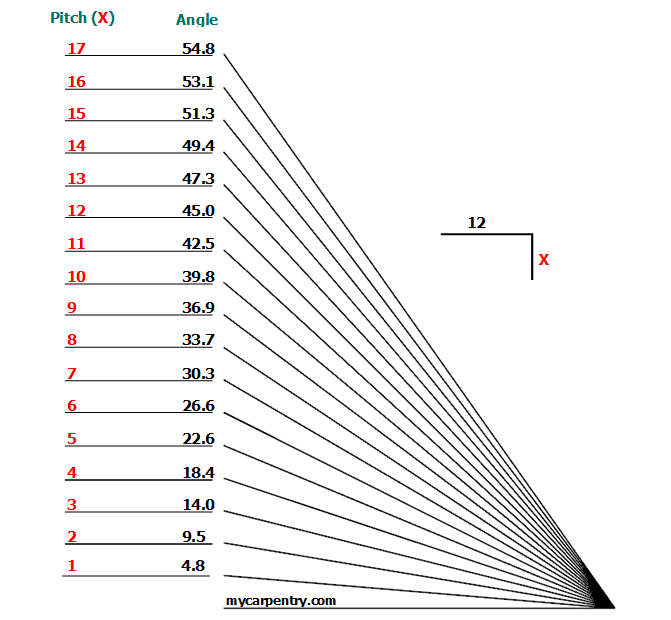
Contractors charge more the steeper the roof is, because as the roof gets steeper it gets a lot harder to install! Here are the reasons why:
Safety
Roofing is a dangerous profession. The hard working laborers need to be compensated extra for the risk of climbing on a steep roof! OSHA mandates that harnesses be worn on steep roofs. Wearing a harness (usually secured to the ridge beam at the top of the roof) slows down your ability to work.
Tear Off is Messier and More Work
When you tear off a roof, you want to pick up the old materials and throw them into a dumpster in the driveway. If your roof is steep, the materials will slide off all around the house, and then need to be carried all around the way around the house to the front. As we get into in the section on access, roofing materials are heavy and it requires significant labor to dispose of them if they can't be thrown off the roof and into the dumpster.
Installing New Material is More Work
Materials and tools will want to slide off the roof so you need to build shelves to hold them. You need to move slower to stay safe.
Access
When the house is tough to access from the street or driveway, additional labor is required to load the new materials onto the roof and dispose of the materials off the roof.
Loading
Here is how you can load a roof when access is good:
Here's what you have to do when access is not good, and the crane cannot reach the roof. Each bundle weighs around 80 pounds and 75 bundles need to be loaded onto an average size roof. You can also see all of the torn off materials on the ground that they will need to pick up and walk to the dumpster. Loading a roof can vary from $35-75/square. If the house is extremely difficult to access, it can be even more.
Disposal
You want to be able to throw the old roofing materials you tore off right into a dumpster from the roof. If you can't do that, you need to throw them off the roof, then pick them up again and throw them in the dumpster. The average roof has over 3 tons of material on it, so it's a lot of work for the laborers to pick it up again and carry it to the dumpster. Disposal can be from $20-55/square extra due to access.
Complexity
This is generally a minor one, but in some cases can be significant. When you are installing shingles and get to the edge of the roof you need to cut the shingles to fit. If a roof has a lot of planes, you will waste material and it takes more time to cut the shingles. This shouldn't change the cost of the roof by more than 10%.
Who's Installing It
With residential construction in general, you will be surprised how much the bids you receive can vary in price! It is not uncommon at all to see some contractors charge double what others charge for the same project. At the end of the day pricing is dictated by supply and demand.
Here's some reasons why:
Supply and Demand
If a contractor is busy, they will generally raise prices so they do not get overwhelmed with work. If they are slow, they will lower prices so they can stay busy. A contractor that has been in business a long time and has a great reputation will generally be expensive! If they charged less, they would have to turn away work, or add more labor and risk compromising quality.
Cost Structures
Different contractors have different cost structures. Bigger companies have higher overhead, but may get better deals on materials. One of the biggest differences we see between contractors is marketing costs. Many contractors work entirely off of word of mouth, and have no marketing costs. Some contractors spend big money on ads and salespeople. These costs need to be factored into the price they charge for the roof, or they will lose money.
It is generally true that you get what you pay for. However, it is not always that simple. There are great contractors that keep a low price in order to ensure they are always busy and maintain the reputation of being well priced. There are also terrible contractors that charge very high prices because they only need to win a tiny percentage of jobs they bid to make significant profits.
Many contractors price opportunistically, charging higher prices to customers they think they can get to pay. For example if they think a customer has more money or they don't think the customer is shopping, they may charge a higher price. Many contractors do not price opportunistically, but it is important to get multiple bids to protect yourself.
Sometimes the very high prices you see are because a contractor is too busy to get to the work and figures they'll do it if they are making a large margin, or they do not want to work with a property owner.
Miscellaneous and Minor Factors
Flashings
Chimneys, skylights, and counter-flashing at roof-to-wall junctures can require some custom work to make sure they are waterproof. A roofer may need to build a cricket to ensure water doesn't pool and seep in to the edge of the skylight, chimney, or other large objects. These can cost a few hundred dollars in materials and labor costs.
Gutters
It is frequently a good idea to get your gutters done while getting the roof done. Gutters are priced by the foot, and the length of the gutters quoted also needs to include downspouts. Gutters generally cost $7-20/foot. There are options to purchase fancier options like copper gutters.
Number of Stories
This usually does not factor much into the price on residential jobs. But some contractors charge more for 2 story homes.
Local Code Requirements
Some building departments require various items that can increase costs. For example some high fire risk areas require additional fireproofing measures, like gutter guards.
Summary
Many factors influence a roof's overall price. Size and complexity increase both labor and materials, while your location drives labor rates and the cost of shingles or tiles. Steep pitches and difficult access raise installation and disposal expenses, and pre-existing issues like multiple roof layers or dry rot often add tear-off and repair charges. Lastly, who you hire can make a big difference—contractors' prices vary based on their overhead, reputation, and how busy they are.
If you want to see what your specific roof replacement will cost, the fastest way is to request a quote here. Simply enter your address (no phone number required) and you'll get real bids from local contractors—usually within about 20 minutes.